FLO ATLAS of Glass & Ceramics: Field Notes I-II
A living record of process, perception, and play — tracing how matter thinks and how hands learn to listen.

The FLO Atlas is an ongoing field guide to my graduate studies in glass and ceramics — part lab journal, part studio diary, part philosophical drift. Each entry maps experiments across materials, from molten silica to sound waves, from tactile interventions to the chemistry of color. It’s open‑source in spirit: a place where anyone curious about making, science, or sensory experience can follow the intersections.
FLO ATLAS ENTRY: GLASS STUDIO
Atlas Volume I — “Foundations” (2025)
Field Coordinates
Location: Studio Lab (undisclosed)
Medium: Soda-lime glass, enamel, propane torch, wax, silica investment mold
Primary Investigator: Alyx Shepherd, flo Lounge (Maker’s Desk Division)

Field Note I — Dressing for Fire and Friction
Before making, we learned to unmake danger. Glass and ceramics belong to the Fire Arts — materials that move when the air itself becomes unstable.
Clothing is the first containment strategy. Natural fibers — cotton, linen, hemp — resist melting under radiant heat. Synthetic fibers like nylon or spandex, though sleek, can fuse into the skin when confronted with flame.
Fit follows physics: loose sleeves risk entanglement in grinders and saws; tight clothing traps heat against the skin. The safest silhouette balances movement and precision.
Footwear grounds the maker. Closed‑toe shoes, flat and stable, transform the act of standing into self‑preservation.
Eye protection refracts the concept of vision itself. Clear safety lenses for cutting; didymium/ACE lenses for torch work filter sodium flare so we can see without burning.
Respiration is part of the process. Dust, enamel pigment, and silica particulate are suspended in the air; protection matters.
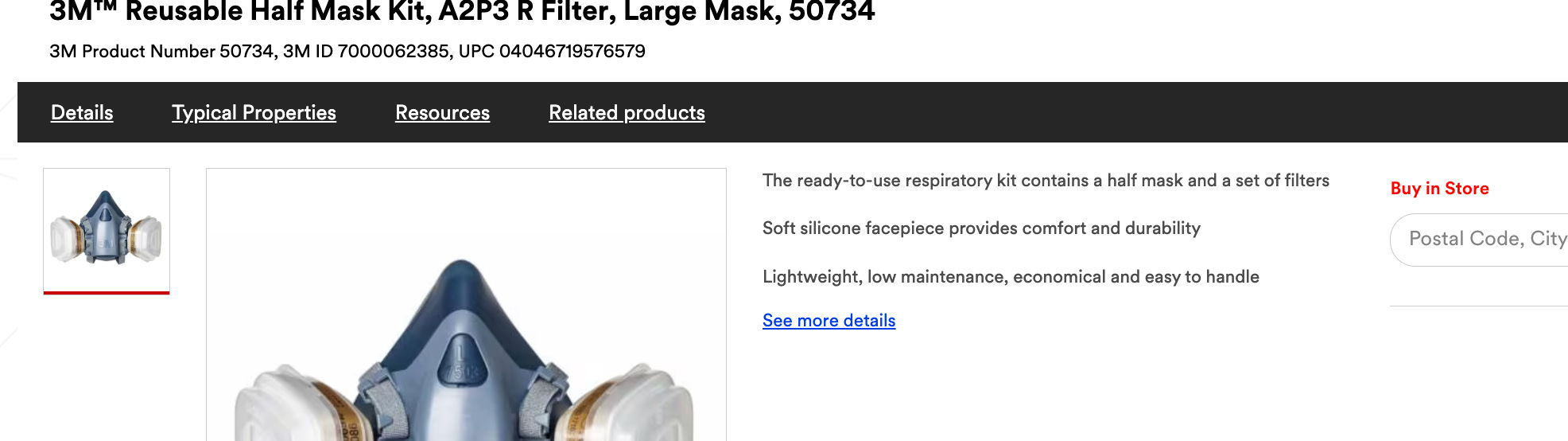
professor recommended: the 3M™ Reusable Half Mask Kit (A2P3 R Filter)—a simple line of defense for every inhale.
Field Note II — Compatibility Trials: What’s the Matter?
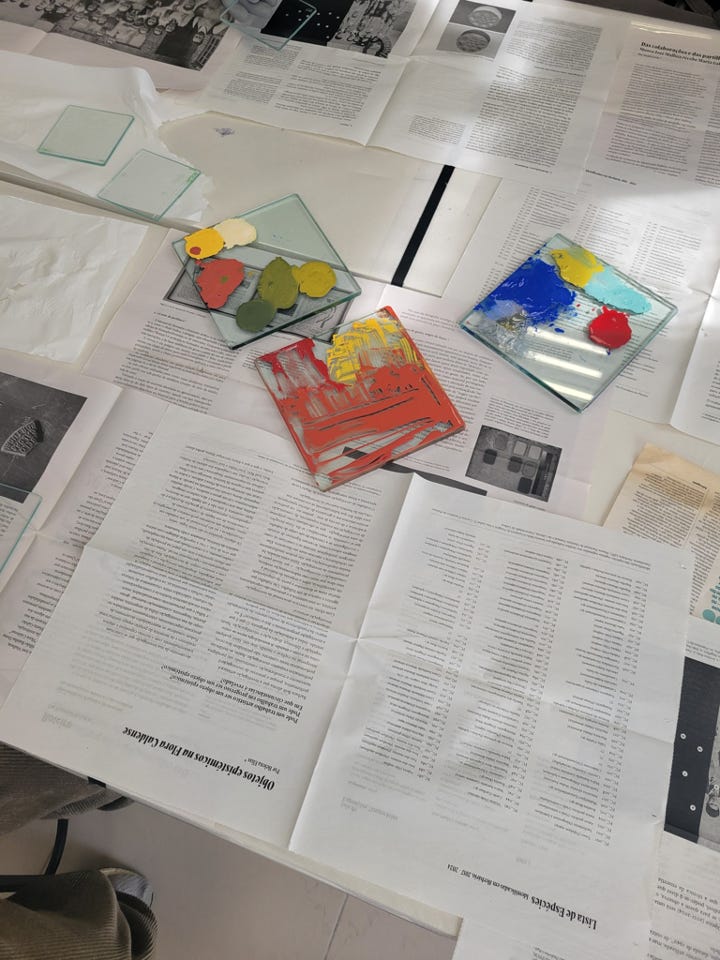
Mixing enamel paints on glass tiles to build palettes for our compatibility experiments.
Glass is a metastable amorphous solid — a liquid arrested in motion. Compatibility matters because each composition expands, contracts, and softens at slightly different rates based on its silica network and modifiers i.e (Na, Ca, B).
We learned to cut tiles, fire up the grinder and ground down the edges, layered color, and ran a three‑temperature firing series. Some cracked, some fused, some slumped.
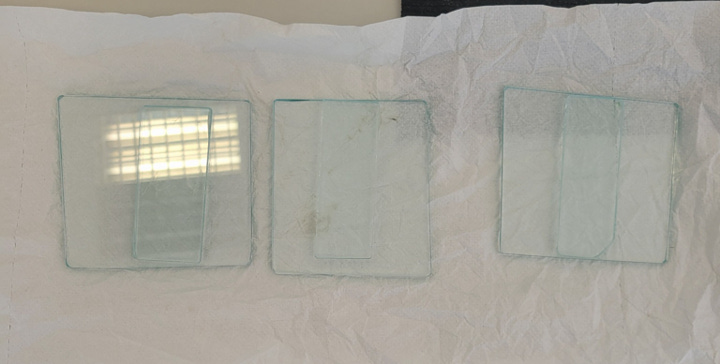
The Two Sides of Glass- Shady
What we call a sheet of glass looks uniform to the naked eye, but it isn’t truly symmetrical.
Most architectural and studio glass today is float glass, produced by cooling molten silica on a bath of liquid tin.
The surface that rested against the tin is called the “tin side,” while the surface exposed to air is the “air side.”
Under normal light they appear identical, but the tin side carries trace metal ions absorbed during forming — invisible until examined under ultraviolet light with a Tin Side Detector, where the tin-bearing surface fluoresces faintly violet-blue.The distinction matters because the two sides differ microscopically in surface energy and ion distribution.
When heated, the tin side softens and interacts with enamels or adhesives slightly differently from the air side, influencing fusion, coating adherence, and optical clarity.
Orientation therefore becomes a hidden variable: reversing top and bottom between firings can introduce subtle stresses or surface reactions that complicate compatibility studies.To keep our experiment a bit more standardized, our team etched the letter “A” into one corner of every tile to mark its air side.
That small incision became our north arrow — ensuring that each sample faced the kiln the same way, allowing us to attribute differences to chemistry, not confusion.
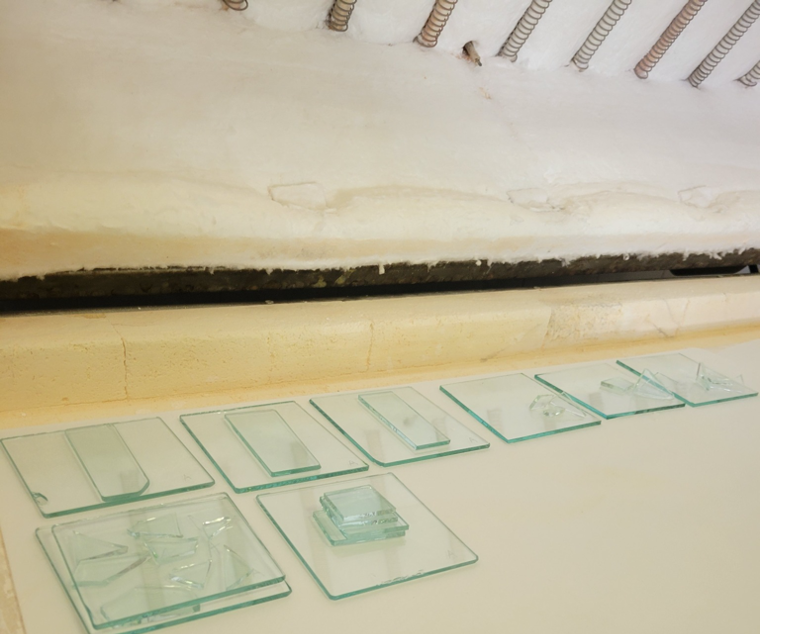
Loaded on the kiln shelf: single layers vs. stacked layers to observe viscosity and stress behavior. Firing 1 Temp: ~685C Firing 2 Temp:~750C Firing 3 Temp:~850C
Two glasses are compatible when they can be fused without locking in stress.
COE describes low‑temperature expansion, but viscosity curves through softening/working/anneal/strain points control how stress relaxes. Even small mismatches can produce tensile stress along joins.
Orientation affects heat absorption and cooling rate — the air‑facing top often runs hotter than the shelf‑side bottom. A top–bottom gradient of ~5 °C during annealing can trap strain; thus, in practice, glass has a top and a bottom.
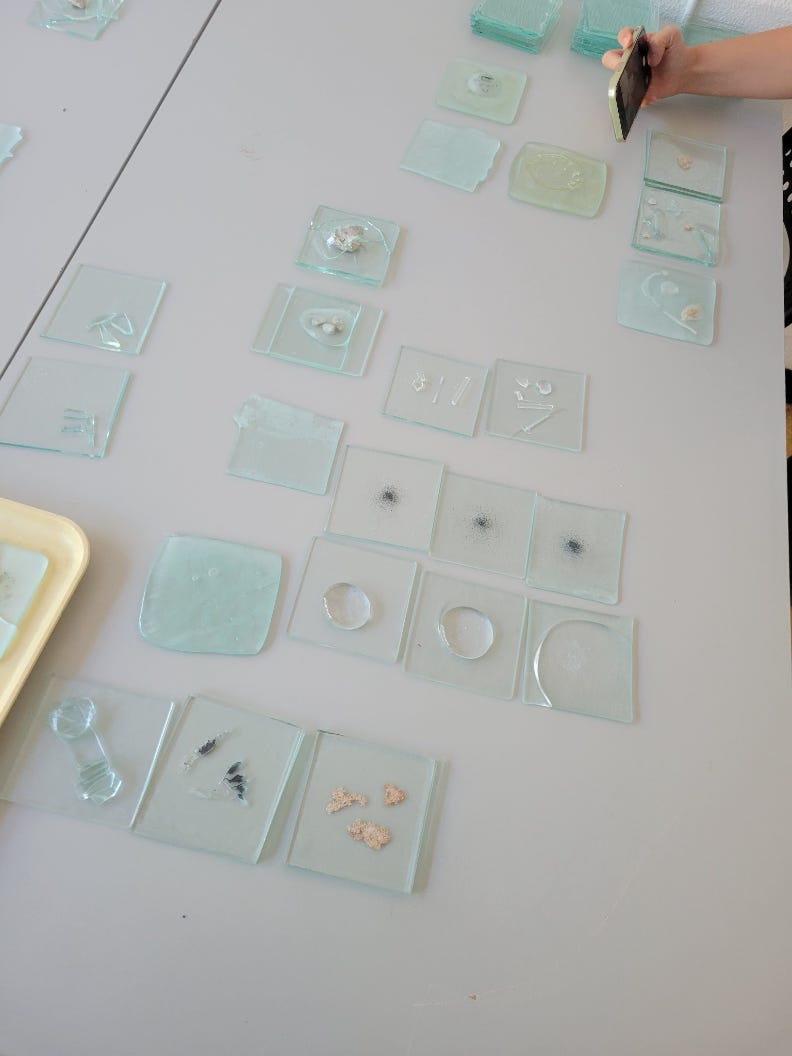
Post‑firing survey: comparing fused, cracked, and slumped samples for visible stress response.
Driving the point home
Back in the lab, we viewed stress birefringence under a polariscope. Rainbow isochromatic fringes mapped internal strain — contours of the glass’s thermal history. Few, faint fringes imply a good anneal; dense, warped colors at joins signal stress.
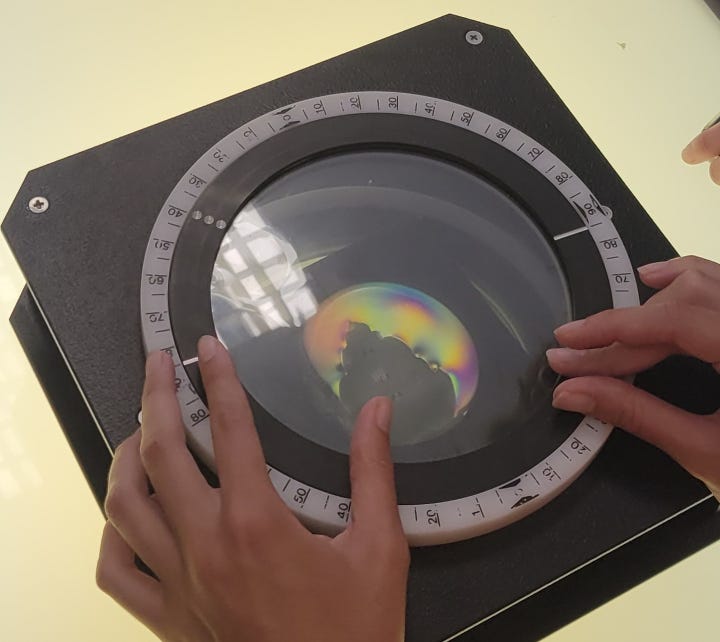
We also examined our samples under the same Lens to make compatibility comparisons.
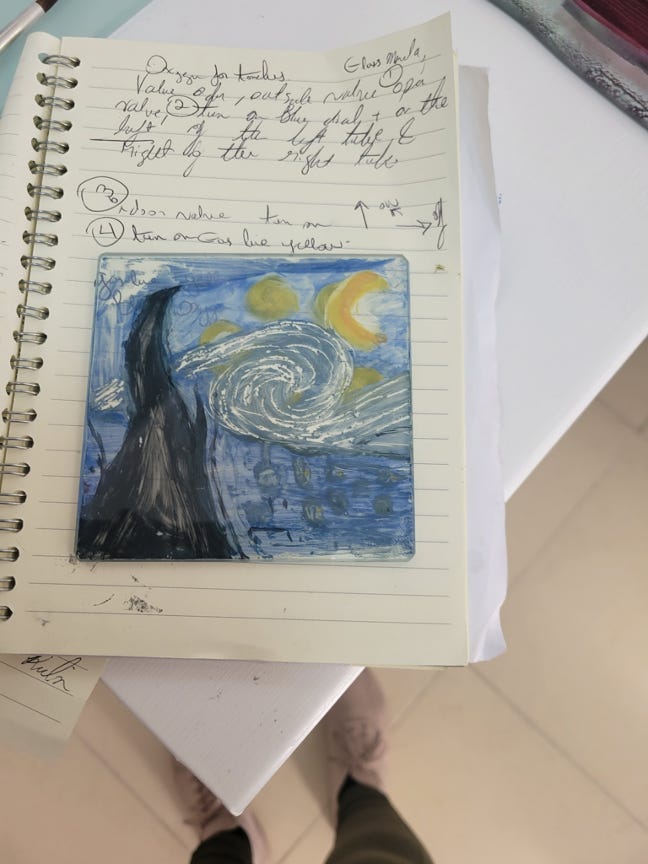
This enamel test tile — loosely inspired by Van Gogh’s Starry Night — became my first real encounter with how color, opacity, and firing schedule interact in glass painting.
The enamels, a mixture of finely ground glass pigment and binder, reacted to both temperature and layering density: thicker deposits yielded uneven surface tension, while thin washes fused cleanly and revealed greater luminosity.
The experiment reminded me that enamel behaves less like paint and more like chemistry in suspension — each layer a balance between viscosity, coefficient compatibility, and melt time.
It was an imperfect but encouraging first study, and I’m eager to refine it through better pigment mixing and more deliberate sequencing of layers in future firings.

From the kiln’s glow to the color of strain itself, the work begins to hum with heat even after it cools.
But fire is fickle; it demands language, rhythm, and respect before it can be shaped.
Next, we learn to speak flame.
Upcoming Field Notes:
III — Torch & Technique – The language of valves, pressure, and precision; the way heat becomes a sculptural tool in glass.
IV— Lost Wax & Babyhead – How wax yields, glass inherits, and nothing solid stays the same for long.